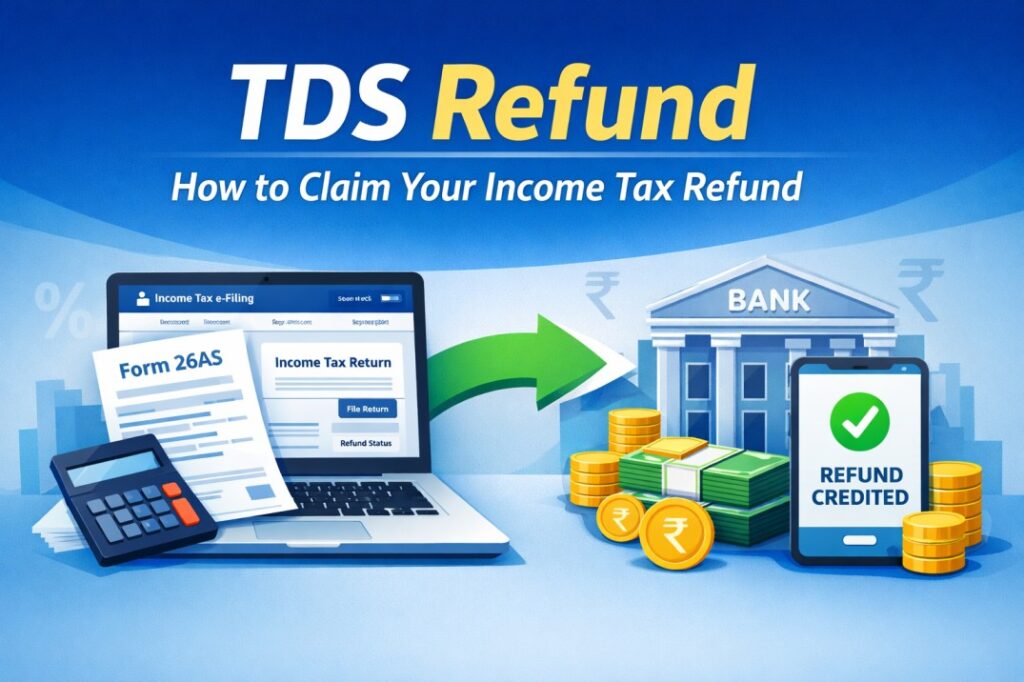
Tax Deducted at Source (TDS) is a process through which tax is collected by the government at the time of making payments such as interest, salary, commission, or professional fees.
In some cases the amount of tax deducted by the payer is higher than the actual tax liability of the taxpayer. In such cases, the taxpayer becomes eligible to claim a TDS refund while filing his Income Tax Return.
Now, we will understand how to claim a TDS refund which is important to ensure that you do not lose refund of money that rightfully belongs to you.
What Is TDS Refund?
A TDS refund occurs when the tax deducted by the deductor is higher than actual income tax payable by the taxpayer for that financial year (FY).
In simple :
If tax deducted is higher than the tax liability calculated while filing the Income Tax Return (ITR), the excess amount will be refunded by the Income Tax Department.
Situations Where TDS Refund Is Common
A TDS refund generally arises when the tax deducted during the financial year exceeds the final tax liability calculated while filing the ITR. This situation is quite common because TDS is deducted based on estimated income, whereas the actual tax liability is determined only after considering total income, deductions, and exemptions.
Below are some of the most common situations where taxpayers become eligible to claim a TDS refund while filing ITR.
1. Excess TDS Deducted by Employer
In the case of salaried employees, employers deduct tax under Section 192 of the Income Tax Act based on the estimated annual income of the employee.
During the beginning of the financial year, the employer estimates the employee’s salary and deducts TDS accordingly. However, this estimate may not always match the final taxable income.
A TDS refund may arise in situations such as:
• The employee did not submit proof of investments during the year.
• The employer assumed higher taxable income.
• The employee changed jobs during the year.
• Some deductions were not considered while calculating TDS.
Example
Suppose an employee earns ₹8,00,000 during the year.
The employer deducts TDS of ₹40,000 based on estimated taxable income.
Later, while filing the return, the employee claims deductions under Section 80C, Section 80D, and NPS, reducing taxable income.
Actual tax liability becomes ₹28,000.
Since ₹40,000 was already deducted, the taxpayer becomes eligible for a refund of ₹12,000.
2. Interest Income Below Taxable Limit
Banks are required to deduct TDS under Section 194A when interest on fixed deposits exceeds the prescribed threshold.
Currently, banks deduct TDS at 10% if interest exceeds the specified limit during a financial year.
However, TDS deduction by banks is not linked to the overall taxable income of the depositor. Banks simply deduct tax when interest crosses the threshold as per the TDS section
Therefore, individuals whose total income is below the taxable limit may still face TDS deduction.
This often happens in the following cases:
• Senior citizens receiving interest income from fixed deposits
• Students or individuals without regular income
• Retired individuals with small income sources
• Housewives holding fixed deposits
Example
Interest from fixed deposit = ₹60,000
Bank deducts TDS @10% = ₹6,000
But if the total income of the individual is below the basic exemption limit, the actual tax liability becomes zero.
The entire ₹6,000 becomes refundable when the person files the income tax return.
3. Multiple Sources of TDS Deduction
Many taxpayers earn income from multiple sources such as:
• Salary
• Interest from banks
• Freelance or professional income
• Commission or brokerage
• Contract payments
In such cases, different deductors may deduct TDS independently, without knowing the taxpayer’s complete income profile.
Since each deductor calculates TDS separately, the total tax deducted may sometimes exceed the actual tax payable.
Example
A taxpayer has the following income sources:
Salary income – TDS deducted by employer
Bank interest – TDS deducted by bank
Freelance work – TDS deducted by client
While each deductor deducts tax individually, the combined tax deducted may exceed the actual tax liability after deductions and exemptions are applied.
The excess amount can then be claimed as a refund while filing the income tax return.
4. Claiming Deductions While Filing ITR
Another common reason for TDS refund is when taxpayers claim deductions at the time of filing their return that were not considered during TDS deduction.
During the financial year, many employees may not submit investment proofs to the employer, or the deductor may not have complete information about deductions available to the taxpayer.
However, while filing the Income Tax Return, taxpayers can claim deductions such as:
• Section 80C – Investments in PPF, ELSS, life insurance, Tution Fees etc.
• Section 80D – Health insurance premium
• Section 80CCD(1B) – Additional deduction for NPS contribution
• Section 80G – Donations to approved charitable institutions
• Section 24 –Housing loan Interest
These deductions reduce taxable income and consequently reduce the final tax liability.
Example
Total income = ₹9,00,000
TDS deducted during the year = ₹55,000
At the time of filing ITR, the taxpayer can claims:
• ₹1,50,000 deduction under Section 80C
• ₹25,000 deduction under Section 80D
• ₹50,000 deduction under NPS
These deductions reduce taxable income significantly, lowering the tax liability to ₹38,000.
Since ₹55,000 was already deducted as TDS, the taxpayer becomes eligible for a refund of ₹17,000.
5. TDS Deducted at Higher Rate Due to PAN Issues
Sometimes taxpayers forget to provide their PAN to the deductor.
In such cases, the Income Tax Act requires the deductor to deduct TDS at a higher rate under Section 206AA.
When the taxpayer later files the income tax return with PAN details, the final tax liability may be lower than the TDS already deducted.
This difference becomes refundable.
How to Check Your TDS Details
Before claiming a refund, you must verify the tax deducted.
You can check this through:
- Form 26AS
- Annual Information Statement (AIS)
- TDS certificates such as Form 16 or Form 16A
These documents show the amount of tax deducted and deposited with the government in your PAN.
How to Claim TDS Refund
The process of claiming TDS refund is done through filing the Income Tax Return (ITR).
Step 1 – Collect Income Details
Gather information about your income from:
- Salary
- Interest income
- Professional income
- Any other sources
Step 2 – Verify TDS in Form 26AS
Check whether the TDS deducted by the deductor appears correctly in your Form 26AS.
If the amount is not reflected, you should contact the deductor before filing your return.
Step 3 – File Your Income Tax Return
While filing the ITR:
- Report all income
- Claim eligible deductions
- Enter TDS details as per Form 26AS
The system automatically calculates your tax liability.
Step 4 – Refund Calculation
If the TDS already deducted is greater than the calculated tax liability, the excess amount becomes refundable.
Step 5 – E-Verify Your Return
After filing the return, you must e-verify it using one of the following methods:
- Aadhaar OTP
- Net banking
- Digital signature
- Bank account verification
Only after verification will the refund be processed.
Example of TDS Refund
Let us understand this with a clear & simple example.
Suppose your salary income during the year is ₹6,00,000.
Your employer deducted TDS of ₹30,000 during the year.
After claiming deductions while filing your return, your final tax liability comes to ₹20,000.
In this case:
Tax deducted = ₹30,000
Actual tax liability = ₹20,000
Refund due = ₹10,000
The Income Tax Department will refund ₹10,000 to your bank account.
How Is TDS Refund Paid?
Once the return is processed by the Income Tax Department, the refund is credited directly to the bank account mentioned in your income tax return.
Therefore, it is important to ensure that:
- Your bank account is pre-validated on the income tax portal
- PAN is correctly linked with the bank account
How Long Does It Take to Receive the Refund?
The refund processing time may vary.
Generally, refunds are issued within a few weeks after the return is processed, provided:
- The return is correctly filed
- No discrepancies exist
- The return has been successfully verified
Conclusion
TDS refund is not something that needs to be applied for separately. It is automatically generated when you file your Income Tax Return and the tax deducted exceeds your actual tax liability.
By properly checking your TDS details and filing your return accurately, you can easily claim the refund due to you.
Timely compliance ensures that your excess tax payment is returned without unnecessary delay.
Continue Reading – Financial Knowledge Hub
Stay informed with our expert-written articles designed to simplify complex financial concepts and help you make better financial decisions.
How long does it take to receive a TDS refund?
Normally, the Income Tax Department processes refunds within a few weeks after the return is successfully verified, provided there are no discrepancies in the return.
Can I claim refund of excess TDS deducted by bank?
Yes. If a bank has deducted TDS on interest income and your total taxable income is below the taxable limit, you can claim the excess amount as refund while filing your ITR.
Is TDS refund automatically credited to bank account?
Yes. After your return is processed, the refund is directly credited to the bank account mentioned in your Income Tax Return.
How can I get my TDS refund back?
To claim a TDS refund, file your Income Tax Return (ITR) on the Income Tax e-filing portal, ensuring that the TDS details match with Form 26AS and correct bank details are provided. After filing, e-verify the return, and the Income Tax Department will process the refund automatically and credit the amount directly to your bank account.
Who is eligible for TDS refund?
A taxpayer is eligible for a TDS refund when the tax deducted during the year exceeds the actual income tax liability calculated while filing the Income Tax Return (ITR).
How to claim 100% TDS?
You can claim 100% TDS refund if your total taxable income is below the basic exemption limit or your final tax liability becomes zero after deductions.
Great post
Insightful Post