On August 12, 2025, Parliament passed the Income Tax Bill, 2025, replacing the over 60-year-old Income Tax Act, 1961.
The reform aims to simplify tax laws, boost transparency, and adopt a digital-first framework.
Effective from April 1, 2026, it promises a streamlined and taxpayer-friendly regime.
Major Simplifications Introduced in the New Income Tax Bill 2025
- Removal of redundant provisions and outdated language.
- Sections reduced from 819 (1961 Act) to 536 in the new Bill.
- Chapters reduced from 47 to 23.
- Word count cut from 5.12 lakh to 2.6 lakh.
- Introduction of 39 new tables and 40 new formulas to replace dense legal text.
- Enhanced clarity and readability compared to the 1961 law.
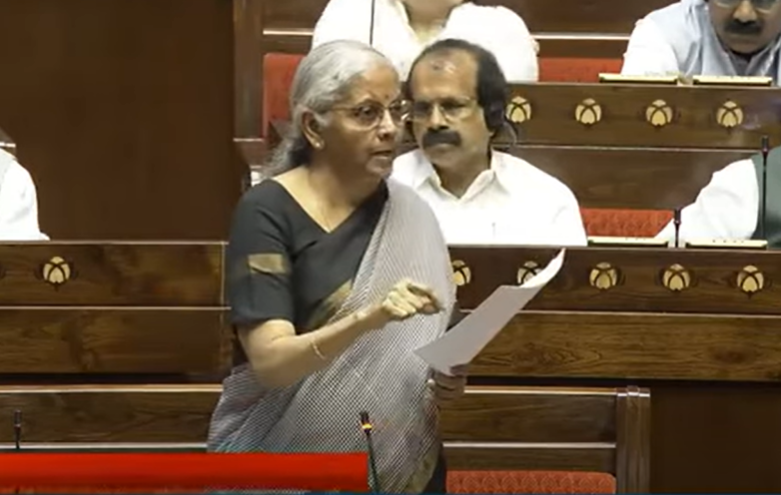
Here are the four major changes Finance Minister Nirmala Sitharaman highlighted (in Lok Sabha on August 12, 2025) as key amendments to the Income Tax Act, 1961, which have since been incorporated into the Income Tax Bill, 2025:
1. Tax Exemption for Sovereign Wealth & Pension Funds
Specified Sovereign Wealth Funds (SWFs) and Pension Funds (PFs) investing in India’s infrastructure sector are granted tax exemption on dividends, interest, and long-term capital gains for investments made between April 1, 2020 and March 31, 2030—subject to government notification. The Public Investment Fund (PIF) and its subsidiaries are explicitly named in the exemption section. This extension builds on the original exemption, which was set to expire in March 2025.
2. Ease of Doing Business: Assessment Abatement in Search Cases
All income-tax assessments for blocked periods in search cases will be abated, i.e., nullified, until an official block-assessment order is issued. This measure aims to reduce compliance complexity and enhance the Ease of Doing Business.
3. Clarity on ₹75,000 Standard Deduction for Salaried Individuals
Under the new tax regime, salaried taxpayers are entitled to a standard deduction of ₹75,000. A drafting error in prior legislation (Finance Act, 2025) had excluded this benefit for FY 2025-26. The amendment corrects this oversight, formally clarifying that ₹75,000 is applicable going forward.
4. Parity for Unified Pension Scheme (UPS) with NPS
To eliminate confusion and ensure uniform tax treatment, the amendment aligns the Unified Pension Scheme (UPS) with the National Pension System (NPS). Key updates include tax exemptions for lump-sum and premature withdrawals under UPS that mirror NPS rules, promoting clarity, equity, and consistency in retirement taxation.
Call to Action: Get Ready for 2026
With the Bill becoming effective from April 1, 2026, businesses and individuals should:
- Familiarize themselves with simplified sections and chapters.
- Adapt record-keeping for faceless, digital-first assessments.
- Revise compliance strategies around the new “Tax Year,” refund rules, and exemptions.
- Stay informed via legal advisories or tax experts ahead of implementation.
Thanks for sharing this kind of information in a way to simplified manner so that every reader of blog can understood easily… 😊🙏
Thanks once again..
And waiting new blog… 🙂
Thanks for sharing this kind of information in a way to simplified manner so that every reader of blog can understood easily… 😊🙏
Thanks once again..
And waiting new blog… 🙂