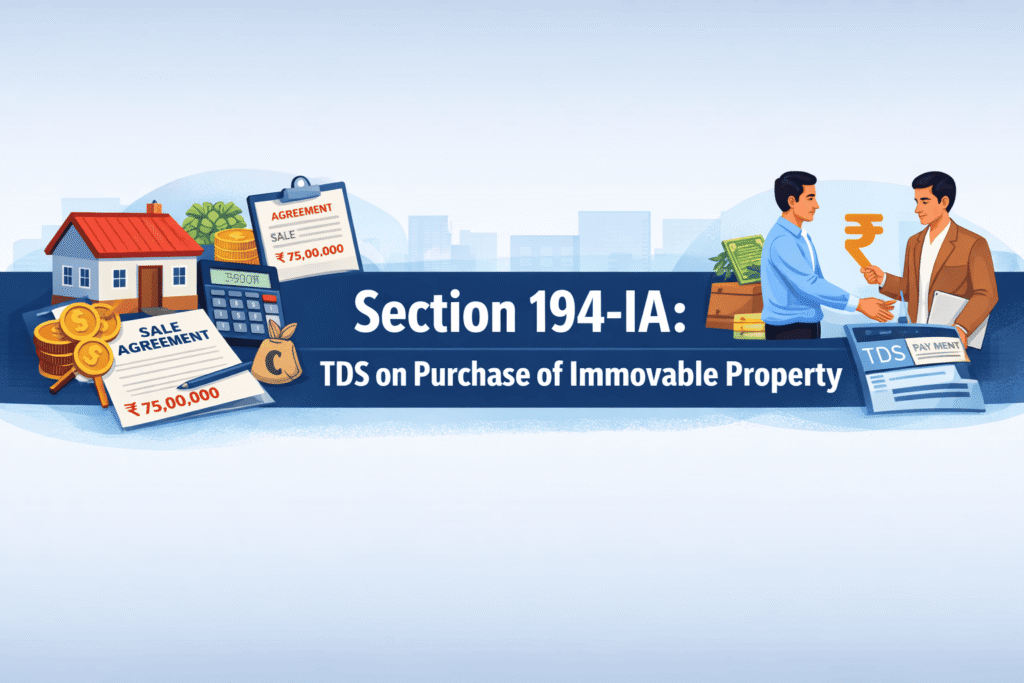
Buying property is a major financial decision, but many buyers don’t realize that under Indian income tax Act, they are also responsible for deducting TDS.
Section 194-IA of the Income-tax Act mandates for deduction of TDS on purchase of immovable property.
This section shifts compliance responsibility from seller to buyer.
What Is Section 194-IA?
Section 194-IA requires the buyer of immovable property (other than agricultural land) to deduct TDS at the time of payment to the seller.
This applies when:
The property value is ₹50 lakh or more.
It does not matter whether the buyer is a salaried individual or a business entity.
If the transaction crosses the threshold, TDS provisions apply.
When Is TDS Applicable?
TDS under Section 194-IA applies if:
- Consideration for transfer of the property is ₹50 lakh or more
- Property is immovable (land, commercial property, building, flat,)
- Not applicable to agricultural land
The threshold applies per transaction.
Even if payment is made in installments, TDS must be deducted from 1st installment, because the total consideration exceeds ₹50 lakh.
TDS Rate Under Section 194-IA
- 1% of sale consideration
If seller does not provide PAN:
- TDS must be deducted at 20%.
Let’s Study – Practical Example
Vijay purchases a flat in Pune for ₹75,00,000.
Vijay must :
- Deduct 1% TDS = ₹75,000
- Pay seller ₹74,25,000
- Deposit ₹75,000 with government
Vijay must then file Form 26QB within the prescribed time.
This compliance responsibility lies on the buyer — not the seller.
Time Limit For Depositing Tax Amount ?
The TDS on the immovable property has to be paid using Form 26QB within 30 days from the end of the month in which TDS was deducted.
Also Learn how to File Form 26QB – Click here
When Should TDS Be Deducted?
TDS must be deducted:
- At the time of payment or
- At the time of credit
Whichever is earlier.
If payment is made in stages (construction-linked plan), TDS must be deducted on each installment.
How to Deposit TDS Under Section 194-IA?
Step-by-step process:
- Deduct 1% from payment
- File Form 26QB online
- Deposit TDS within 30 days from end of month of deduction
- Generate Form 16B (TDS certificate)
- Provide Form 16B to seller
Very important :-
No TAN number is required.
PAN of buyer and seller is mandatory.
Important Points for Buyer & Seller
- If multiple buyers → Each buyer must deduct proportionate TDS
- If multiple sellers → Separate Form 26QB for each seller
- Stamp duty value may also impact compliance
- Late filing attracts interest and penalty
Interest and Penalty for Non-Compliance
If TDS is not deducted:
- Interest at 1% per month (for delay in deduction)
- 1.5% per month (for delay in deposit)
- Late filing fee under Section 234E may apply
Property transactions are high-value. Non-compliance can trigger scrutiny.
Consequences of Non-filing Form 26QB
If the buyer fails to file Form 26QB after deducting TDS, the tax deducted will not appear in the seller’s Form 26AS. As a result, the seller will not be able to claim TDS while filing the Income Tax Return. This can create a serious issue the seller has to pay tax again on the same income while reporting capital gains for the financial year. Until the TDS is properly reported and reflected in Form 26AS, the credit cannot be claimed, leading to unnecessary tax burden and compliance complications.
Continue Reading – Financial Knowledge Hub
Stay informed with our expert-written articles designed to simplify complex financial concepts and help you make better financial decisions.
Frequently Asked Questions
Should TDS be deducted on total property value or only on amount paid?
TDS must be deducted on the entire sale consideration, not just advance amount.
If payment is made in installments, 1% TDS must be deducted on each installment once the total agreement value is ₹50 lakh or more.
Is TAN required for filing TDS under Section 194-IA?
No.
Unlike regular TDS provisions, TAN is not required under Section 194-IA. The buyer can directly file Form 26QB using PAN.
However Both buyer’s and seller’s PAN are mandatory.
What happens if buyer fails to deduct or deposit TDS?
If TDS is not deducted or deposited:
- Interest at 1% per month for delay in deduction
- Interest at 1.5% per month for delay in deposit
- Late filing fee under Section 234E
- Possible penalty proceedings
Non-compliance can also delay property registration in some cases.
Does Section 194-IA apply when buying property from an NRI?
No.
If the seller is a Non-Resident (NRI), Section 194-IA does not apply.
In such cases, Section 195 applies, and TDS must be deducted at applicable capital gains rates (which are much higher than 1%).
This is a critical distinction.
Buying from NRI without proper TDS deduction can create significant tax exposure.
Is TDS applicable on stamp duty value or agreement value?
TDS is generally deducted on higher of sale consideration or stamp duty value, as per applicable rules.
If stamp duty valuation exceeds agreement value, compliance should be examined carefully.
Professional verification is recommended in such cases.
If there are multiple buyers or sellers, how is TDS handled?
In case of:
- Multiple buyers → Each buyer deducts TDS proportionately
- Multiple sellers → Separate Form 26QB must be filed for each seller
Compliance becomes slightly technical in joint ownership cases.